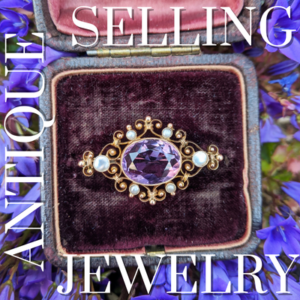
It is a common assumption that old jewelry is worth less than new jewelry. In the antique market, the opposite is often true. Demand for antique and period jewelry has grown steadily for years, driven by collectors, designers and buyers who want pieces that cannot be reproduced. If you have inherited or held onto antique jewelry, here is what makes it valuable, how it is evaluated, and how to sell it in New York for what it is really worth.

Why Antique Jewelry Is in Demand
- It is genuinely rare. A piece made in 1890 has survived over a century of wear, resizing, theft, loss and the melting pot. The ones that remain are scarce by definition.
- It was made by hand. Before mass production, jewelry was fabricated, engraved and set by craftsmen. Filigree, millegrain edges, hand-cut stones and closed-back settings are difficult and expensive to replicate today.
- It is fashionable again. Estate engagement rings, Art Deco bracelets and Victorian lockets appear constantly in film, television and on social media. Buyers under 40 are a growing share of the antique market.
- It holds value. Fine antique jewelry does not depreciate the way new retail jewelry does the moment it leaves the store. Well-documented pieces from strong periods tend to appreciate.
The Main Periods and What They Look Like
- Georgian (1714–1837): Closed-back settings, foil-backed stones, hand-cut rose and old mine diamonds, very rare on the market.
- Victorian (1837–1901): Sentimental motifs, seed pearls, garnets, mourning jewelry, snake designs, yellow gold.
- Edwardian (1901–1915): Platinum, lace-like openwork, diamonds and pearls, delicate garland style.
- Art Nouveau (1890–1910): Flowing organic lines, enamel, moonstones and opals, nature motifs.
- Art Deco (1920–1935): Geometric shapes, platinum, calibre-cut sapphires and emeralds, old European cut diamonds. The most sought-after period today.
- Retro (1935–1950): Bold rose and yellow gold, large cocktail rings, tank bracelets.
How Antique Jewelry Is Valued
A general gold buyer will weigh an antique piece and offer melt value. That is the wrong way to value it, and it is where sellers lose money. Our appraisers evaluate antique jewelry on several layers:
- Intrinsic value. The gold or platinum content and the weight and quality of the stones.
- Period and authenticity. Construction methods, hallmarks, cut styles and wear patterns confirm the age.
- Maker. Signed pieces from Tiffany & Co., Cartier, Van Cleef & Arpels, Boucheron, Marcus & Co. and other houses carry strong premiums.
- Condition and originality. Original stones and unaltered mountings are worth more than pieces that have been repaired with modern parts.
- Market demand. We reference current auction results and dealer prices for comparable pieces.
Should You Sell an Heirloom?
That is your decision, and there is no wrong answer. Many customers simply want to know what a piece is worth before deciding. Our evaluation is free and there is no pressure to sell. Some choose to sell one or two pieces from a collection and keep the ones with the most personal meaning. Others prefer a collateral loan, which lets them borrow against the jewelry without giving it up.
Tips Before You Bring Antique Jewelry In
- Do not clean, polish or repair the piece first. Patina and original surfaces are part of the value.
- Bring any boxes, receipts, appraisals or family documentation. Provenance adds value.
- Keep sets together. A matching brooch and earrings are worth more as a suite.
- Bring a government-issued photo ID.
Sell Antique Jewelry in the NYC Diamond District
Unlimited Buyers purchases antique, vintage and estate jewelry at 37 W. 47th St, Suite 203, in the Diamond District. We are BBB accredited, open seven days a week from 9am to 9pm, and we buy single pieces as well as entire estates and collections. Call 212-764-6725, visit our fine jewelry buyer page, or request a free offer online.